
CIC president touts million-dollar impact of technology park in Louisiana
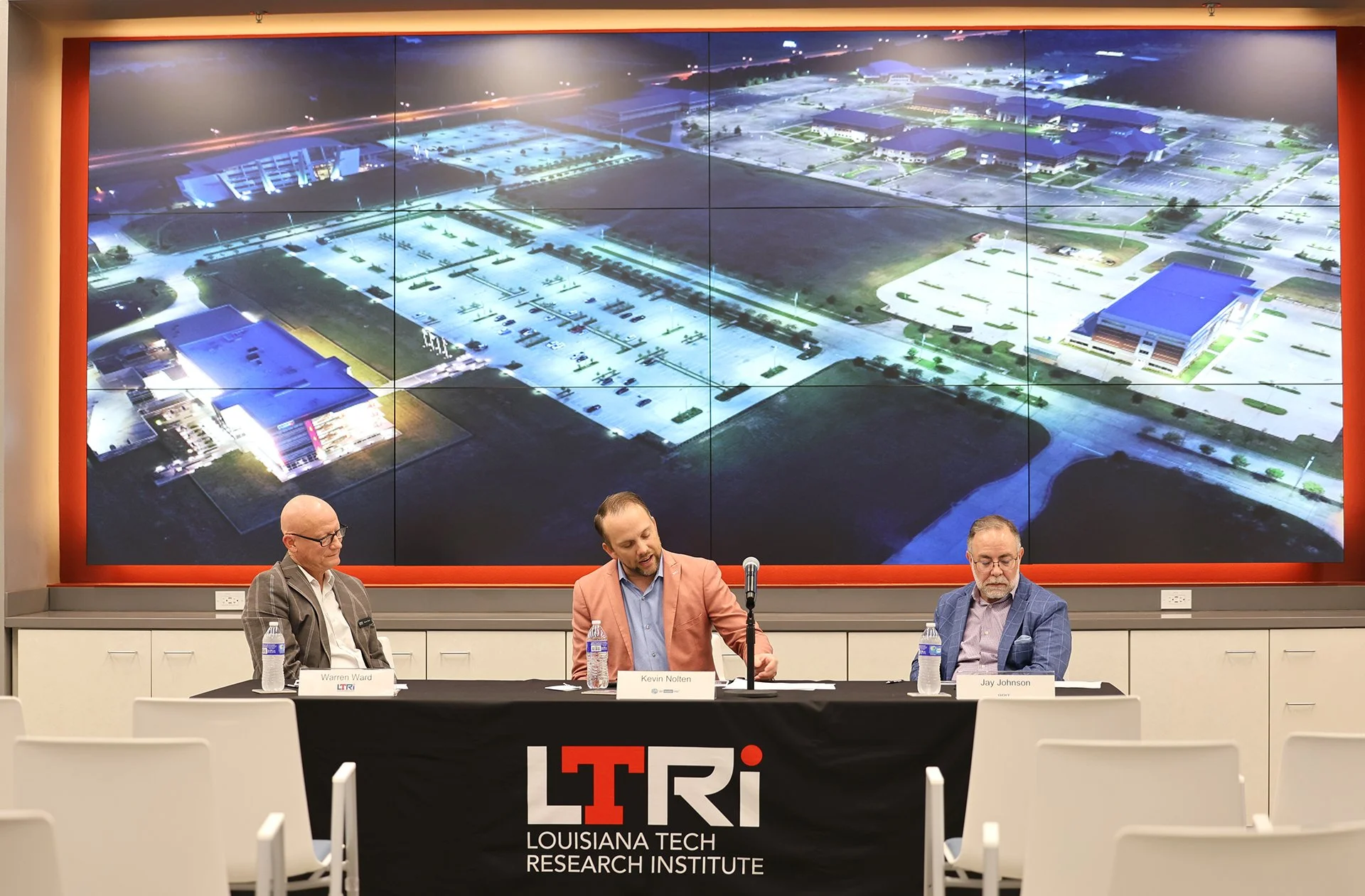
Cyber Innovation Center President Kevin Nolten, center, leads an Innovation Summit on the impact of the National Cyber Research Park in Bossier City, Louisiana, Nov. 20 at the Louisiana Tech Research Institute (LTRI).. Nolten was joined by LTRI Director Warren Ward, left, and Vice P resident of Technology Shared Services Customer Engagement for General Dynamics Information Technology Jay Johnson, right. (Tessa VanderKuy/Cyber Innovation Center)
By Sean Green | Facilitation and Outreach Manager
Cyber Innovation Center (CIC) President Kevin Nolten led an innovation forum on the National Cyber Research Park (NCRP) at the Louisiana Tech Research Institute (LTRI) Nov. 20 to discuss the evolution of the NCRP and its impact on the community.
He was joined by fellow park tenants Jay Johnson, vice president of Technology Shared Services Customer Engagement for General Dynamics Information Technology (GDIT), and Warren Ward, executive director of LTRI.
Nolten noted the partnership between CIC, GDIT, LTRI, and Bossier Parish Community College (BPCC) as a major factor in their success.
“When we talk about collaboration and innovation taking place, we couldn’t have scripted it any better,” he said. “This is the natural evolution of a community wanting to make a difference.”
A transformation that began 20 years ago, the NCRP is now home to four new buildings with space to continue growing a new industry for the region, creating an educated workforce with high paying careers.
Johnson added, “I don’t build product. I build people. I hope that GDIT is seen as a net talent exporter to the community.”
Nolten said the workforce pipeline and how it’s grown is a priority. CIC’s CYBER.ORG, which provides cybersecurity and AI education and resources to teachers across the United States to transition students into cyber careers, is a major piece of that puzzle.
“CYBER.ORG is growing that pipeline of students for colleges like BPCC, who then feed into organizations like GDIT so Jay can hire them after graduation,” said Nolten. “The National Security Administration is looking to CYBER.ORG for curriculum in their academic outreach. That’s a huge testament to what we’re doing.”
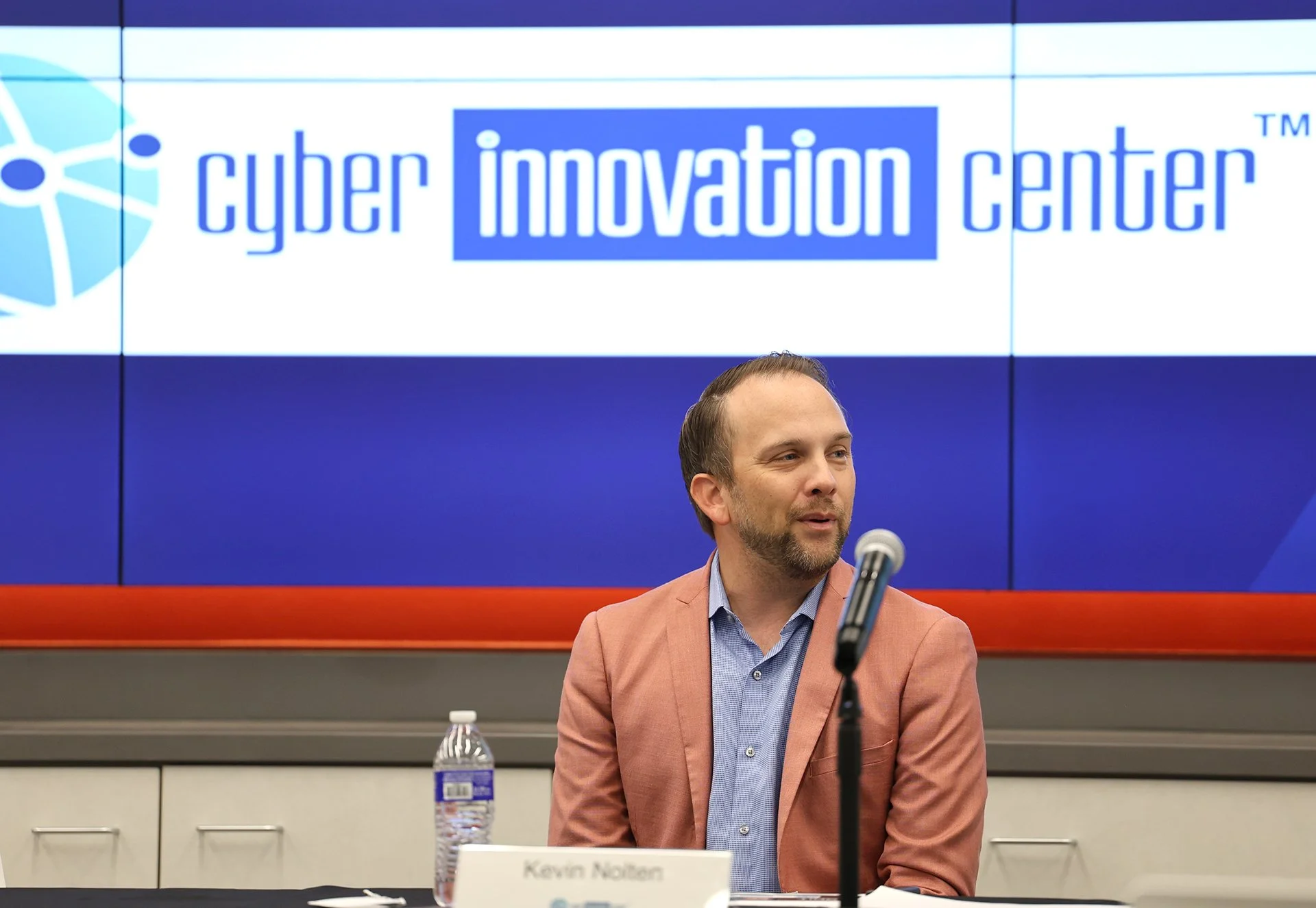
Cyber Innovation Center President Kevin Nolten discussed the impact of the National Cyber Research Park in Bossier City, Louisiana, during an Innovation Summit at Louisiana Tech Research Institute on Nov. 20. (Tessa VanderKuy/Cyber Innovation Center)
The CIC’s partnership with Air Force Global Strike Command (AFGSC) is also a driver for change, with their STRIKEWERX division facilitating new solutions and technology with local and national companies.
“We take those AFGSC pain points and pass them to small business and other non-profits who have a really good idea,” said Nolten. “STRIKEWERX can use their process, data team, software, and 3D printing to find solutions that cost a fraction of traditional defense contractors.”
He highlighted three of STRIKEWERX’s 100 projects and a portion of their cost savings that total more than $300 million:
An augmented reality (AR) trainer for air refueling that cut the number of training flights needed from 13 to six, saving $10 million per year.
A new, wearable software defined radio to replace antiquated alerting technology that will result in one time savings of $200 million for the Air Force.
An AR trainer for security forces in intercontinental ballistic missile fields that eliminated lost equipment costs of $188,000 and 1,000 lost manhours per year.
LTRI, which provides research capacity and education services to support government decision makers, is also supporting AFGSC by building talent through the Global Strike National Security Fellowship Program.
“In five years, we’ve had 45 students from three universities work to solve real world problems for Air Force Global Strike Command (AFGSC),” said Ward.
Nolten added that the collaboration between the NCRP and surrounding businesses is important because it infuses innovation into workforce development, which translates to economic development.
“We all want to build something that is complimentary to the park and its mission,” he said. “We are working to recruit small businesses to create high paying jobs and keep improving the quality of life.”
Johnson added, “GDIT is working to get small businesses built up — I want to see my people leave me and start a business here. I want to expand that ecosystem to the communities in this region.”
About the Cyber Innovation Center
Cyber Innovation Center (CIC), located in Bossier City, Louisiana, is the anchor of the 3,000-acre National Cyber Research Park and serves as the catalyst for the development and expansion of a knowledge-based workforce throughout the region. As a 501c3 not-for-profit corporation, CIC fosters collaboration among its partners and accelerates technology, research, and development. One of its primary missions is to develop a sustainable knowledge-based workforce that can support the growing needs of government, industry, and academic partners.
About the National Cyber Research Park
Serving as the anchor of Louisiana’s Cyber Corridor, Cyber Innovation Center and its National Cyber Research Park (NCRP) provide a physical location for government, industry, and academic partners to collaborate, conduct leading research, and develop state of the art technologies. Strategically located next to Barksdale Air Force Base (Barksdale) in Bossier City, Louisiana, the NCRP is a 3,000 acre overlay district. This location provides easy access to and from the park and offers data centers the connectivity, redundancy, survivability, and collaboration essential for new business development opportunities.