
New defense innovation shields ICBM maintenance from adverse weather
Outcomes and Future Impact
Increased reliability of the “no fail” communications systems for nuclear operations
Minimized risk of weather-related complications
Improved protection of AEHF antenna components
Improved quality of life for Airmen, which increases retention and mission effectiveness
The Challenge
The Intercontinental Ballistic Missiles (ICBMs) make up one third of the nation’s nuclear forces and half of the Air Force Global Strike Command (AFGSC) long range strike capabilities. To ensure readiness, missile maintainers are responsible for the upkeep and readiness of the ICBM fleet in all conditions.
The Advanced Extremely High Frequency (AEHF) system is a critical piece of the communications link between the President of the United States and the Airmen responsible for launching the weapons. To ensure readiness, the antenna itself must undergo a regular maintenance process in which a crane is used to remove the AEHF antenna covering allowing the maintainers to perform their duties, before the cover is secured and re-sealed to keep out moisture. And it's a process that requires maintainers to perform their duties in weather ranging from scorching heat to bitter cold.
Due to extreme temperatures, maintainers must use “Work Rest Cycles” of 40 minutes of work to 20 minutes of rest per person to minimize weather related injuries such as hypothermia or heat exhaustion.
Maintainers spent up to 10 hours per site to remove, perform maintenance, and weatherproof the covering.
AFGSC sought out a way to protect maintainers, reduce time, and improve the process to increase the overall quality of life for Airmen in the ICBM career fields.
Hoping to secure a rapid solution, AFGSC empowered STRIKEWERX, its innovation hub at the Cyber Innovation Center (CIC), to launch its design sprint method.
“Maintainers in our missile fields are always persevering through weather related challenges, and this new solution will help sustain our force’s lethality by making crucial tasks accomplished faster and easier.”
The Solution
The STRIKEWERX design sprint is a five-day effort that brings together a team of business, academia, and government to define the challenge, understand its needs, and then design and test a prototype.
Celina Tent of Ohio was recruited to participate in the sprint due to their experience in producing shelters for Department of War (DoW) clients. Airmen used a scale model to visualize a rapidly deployable, movable enclosure for the AEHF Antenna and Celina Tent produced a digital 3D model from the Airmen’s idea. This would serve as the base for producing a full-size prototype focused on size, durability, versatility, and ease of use.
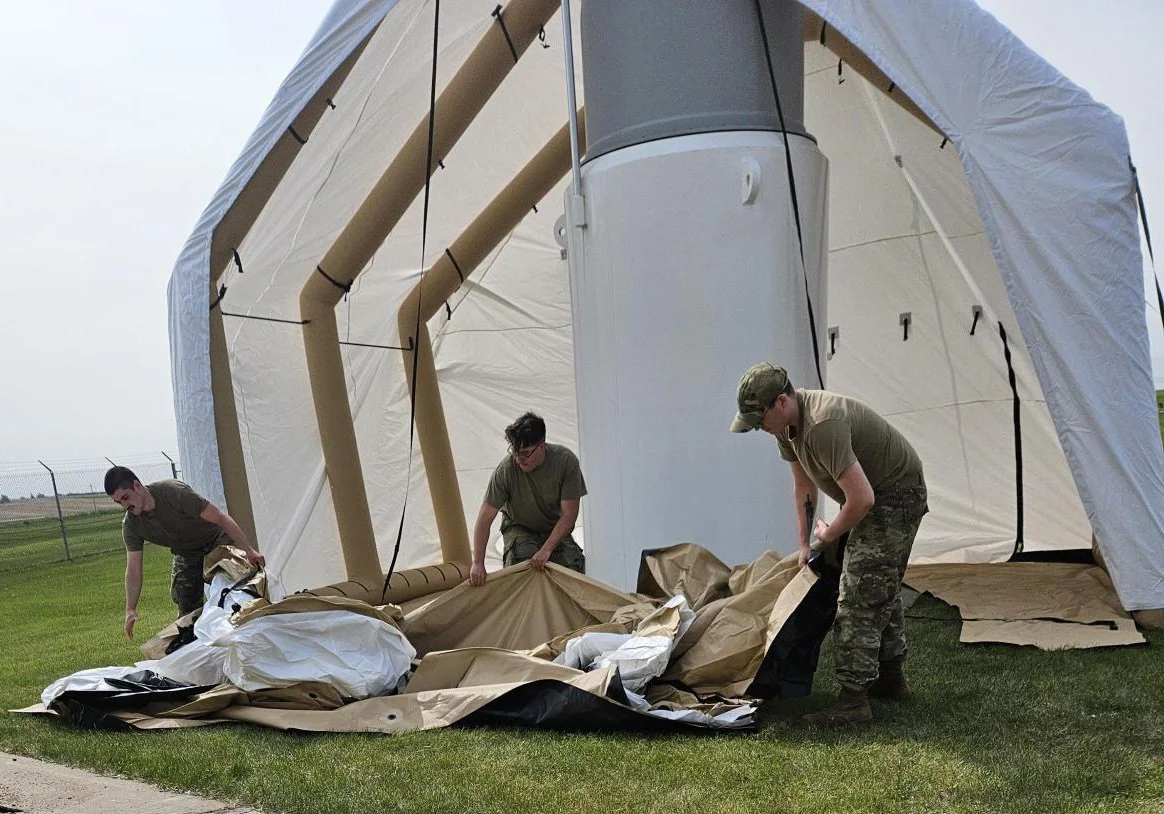
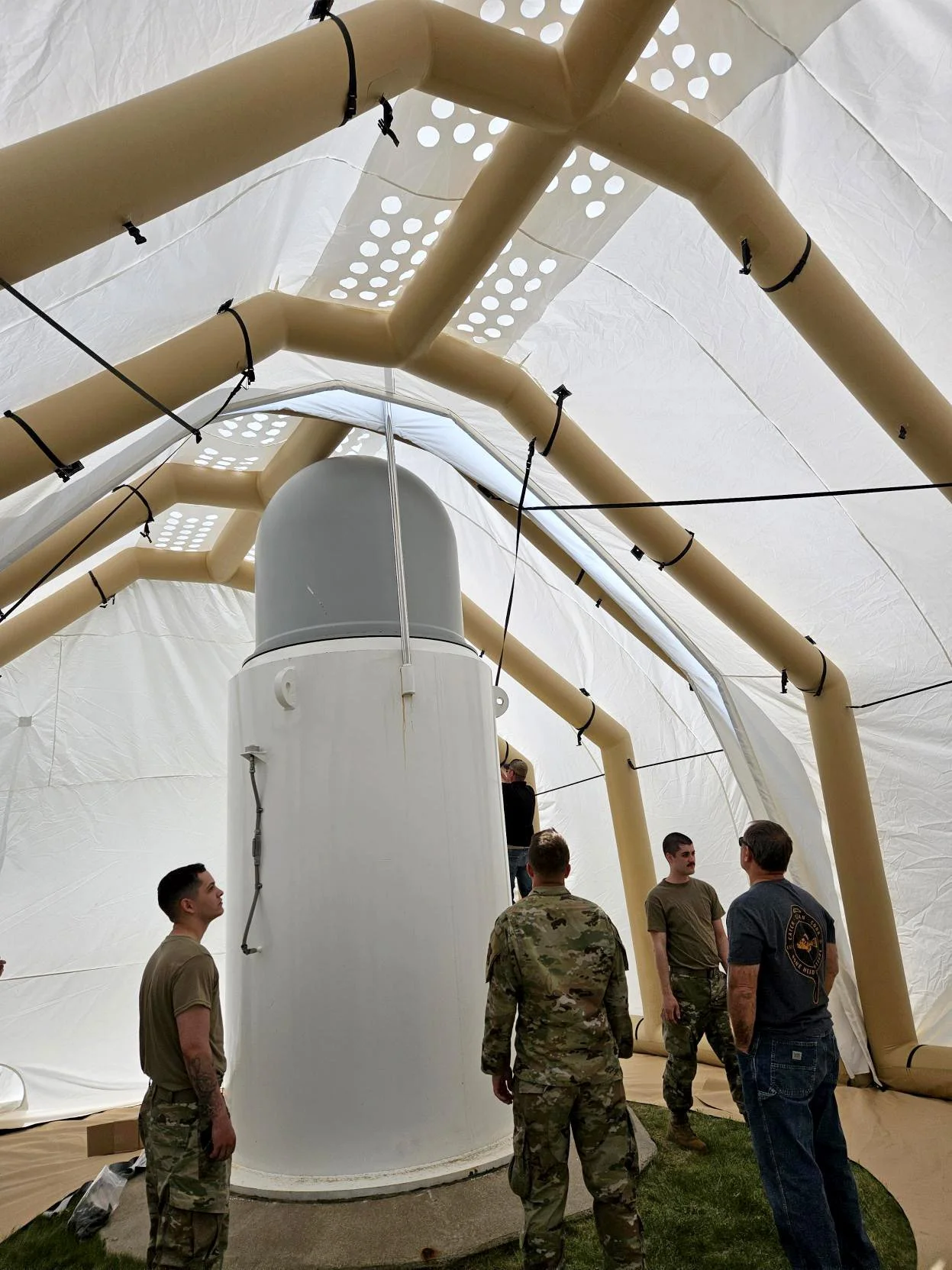
The sprint informed Celina Tent’s proposal to develop a rapidly-inflatable, tent-like shelter. The 14-foot-tall prototype includes two connected shelters. A heater can also be connected to provide a more moderate environment than the -30F North Dakota winter. When the Airmen need to use a crane to service the antenna, the shelters may be briefly disconnected from one another and pivoted open to allow crane access. When crane access is no longer needed, the shelters may be reconnected, and the work area is heated.
Airmen from Barksdale Air Force Base, Louisiana; Malmstrom AFB, Montana; Minot AFB, North Dakota; and F.E. Warren AFB, Wyoming, all worked with STRIKEWERX and Celina Tent to develop requirements for the shelter.
The shelter was tested and further modified, to include a reduction in height from 19 feet to 14.5 feet, a more durable fabric, and stability and usability enhancements such as reinforced straps, fiberglass support rods, and grommets for ground staking. Three shelters were delivered to AFGSC for implementation across all three missile wings, ensuring that the United States’ nuclear deterrent remains safe, secure, reliable, and effective in deterring 21st-century threats and reassuring our Allies and Partners.
All told, the cost of the design and production of prototypes for testing was approximately $248,287.25.
“The Design Sprint process offers great collaboration to work with commercial vendors and leverage current technology, which is not something that most Airmen ever get the opportunity to do. Allowing Airmen to determine what works best energizes them to induce innovative changes to procedures and hopefully makes them more efficient in their job.”
The Result
Since implementation, the command has seen reduced maintenance downtime due to weather, minimized risk of cold- and heat-related injuries, improved protection of AEHF antenna components, and increased efficiency through rapid setup and teardown.
Collectively, these improvements are expected to reduce total maintenance duration and improve overall mission execution.
Based on feedback provided by Airmen, the shelter concept should be evaluated for applicability to other maintenance use cases requiring environmental protection, expanding the operational value of the solution beyond AEHF antenna maintenance.
“The AEHF Antenna Shelter speaks to the heart of our design sprint method. This project illustrates how a small, knowledgeable team of individuals can come together and quickly produce results that impact the command’s mission.””
Visit the STRIKEWERX website HERE to see how it is improving quality of life for Airmen.