
Innovative Equipment Supports Global Deterrence
Outcomes and Future Impact
Reduced shipping footprint by 50% & shipping materials by 100%
Disassemble & rebuild time is less than 30 minutes
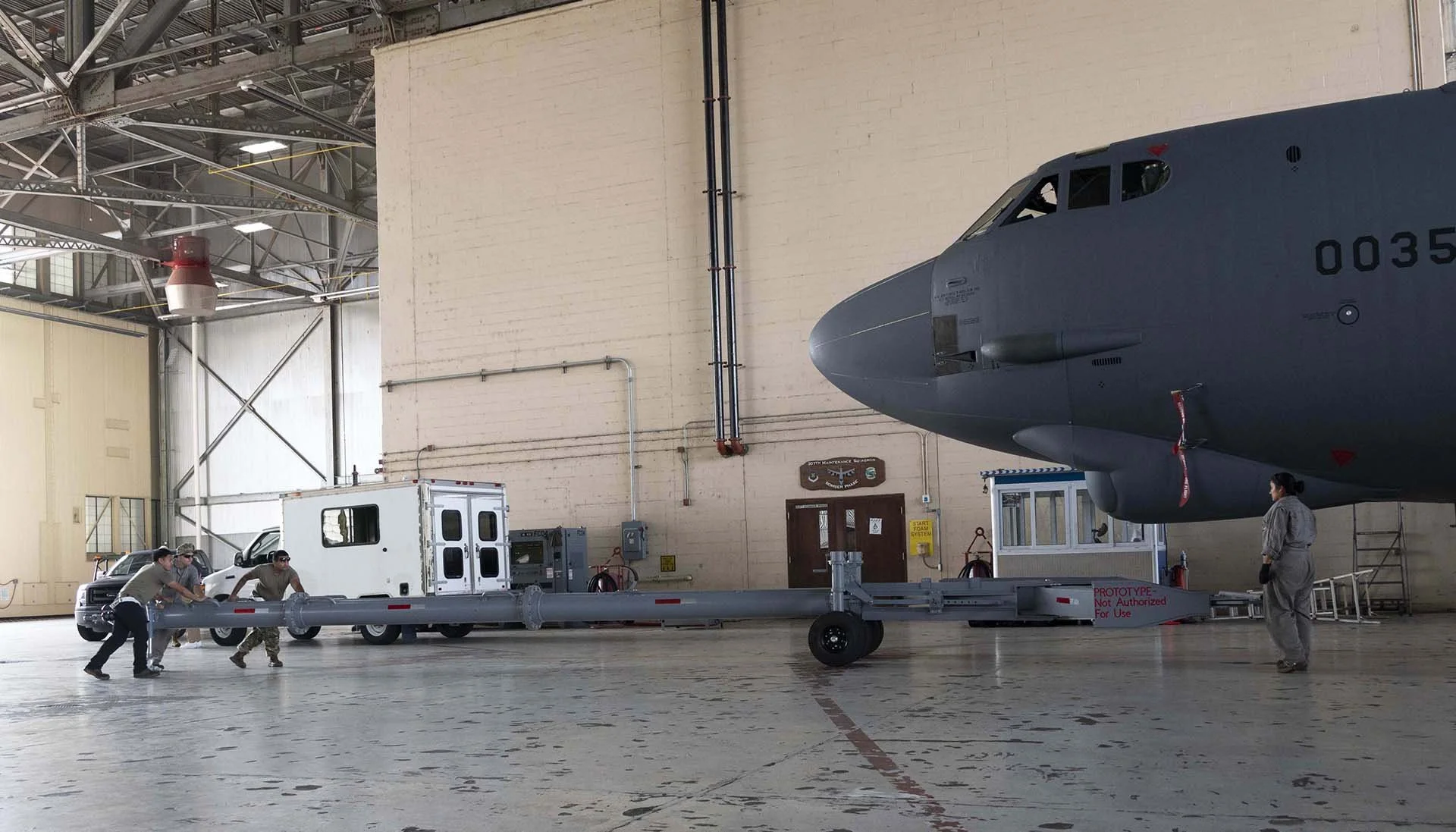
U.S. Airmen, assigned to the 2nd Maintenance Squadron, roll a B-52 Stratofortress towbar prototype into position during a demonstration at Barksdale Air Force Base, Louisiana, Sept. 10, 2024. (U.S. Air Force photo by Senior Master Sgt. Ted Daigle)
The Challenge
When a B-52 Stratofortress is deployed to a remote location, Airmen use a 60 foot long, 6,500-pound towbar to assist in moving the aircraft on the ground for maintenance.
Due to a limited number of B-52 towbars across the Air Force, aircrews can't ensure one will always be available at the deployment location and therefore, it must always occupy space on cargo planes. Because of its size and scale, loading the towbar and moving it in one piece is a challenge, not to mention being time consuming to disassemble. Wooden shoring is also necessary for on-loading and off-loading the towbar, increasing the the weight onboard and the space needed to transport it. These challenges combined, negatively impact the B-52’s agility and mobility.
As a way forward, Air Force Global Strike Command (AFGSC) sought an updated design with new materials that would make it collapsible, reduce weight, and lessen the space necessary for shipment.
Working with STRIKEWERX, the Cyber Innovation Center (CIC)’s innovation hub for AFGSC, this concept was made into a reality.
“This effort is about meeting the needs of the Agile Combat Employment concept and having the ability to project bomber power. The current design isn’t particularly agile and that is creating a demand for towbars that is difficult to meet.”
The Solution
Senior engineering students at their respective schools are often seeking out new ideas for design projects that are required to graduate. Projects usually originate from businesses looking for innovative solutions to their internal challenges. STRIKEWERX however, saw a win-win opportunity to support one local engineering program by allowing students to work on a real-world problem while addressing the AFGSC challenge at hand.

U.S. Airmen, Air Force Global Strike Command officials, and visitors from Louisiana Tech University gather around a new B-52 Stratofortress towbar prototype prior to a demonstration of its capabilities at Barksdale Air Force Base, Louisiana, Sept. 10, 2024. The prototype was designed in a collaboration between Louisiana Tech engineering students, and AFGSC’s innovation arm called STRIKEWERX. (U.S. Air Force photo by Senior Master Sgt. Ted Daigle)
STRIKEWERX approached Louisiana Tech University (LA Tech) based on their proximity to AFGSC headquarters, strong engineering program, CIC’s preexisting relationship with LA Tech, and proven performance on previous projects. By designing the towbar, students would be exposed to Air Force culture, challenges, and potential career opportunities. Meanwhile, AFGSC would see emerging technologies and receive research and development on new designs of aging equipment, new software solutions, improved processes, workflows, and data analysis.
Leveraging STRIKEWERX’s existing relationship with the university, AFGSC was able to present the project to LA Tech’s senior design class. Interested students then created and presented a proposal, and professor Dr. Henry Cardenas selected a final group to make up the project team.
Ultimately, LA Tech was awarded a total of $10,000 in funding through STRIKEWERX to develop a clear, obtainable, and updated design. The project used the students’ pre-existing knowledge and skills, while providing them with valuable real-world experience to develop innovative, mission-ready equipment for the warfighter.
STRIKEWERX managed communication between the Air Force and LA Tech to ensure efficient collaboration on necessary input. Additionally, STRIKEWERX helped LA Tech better understand the project to effectively match students’ skills and interests with the project’s needs to deliver a more functional design.
The LA Tech senior design team defined and analyzed the challenges facing the existing equipment, then fabricated a one-third scale model of their proposed design that would allow them to better evaluate its potential. Using this as a proof of concept, the team presented their findings to AFGSC stakeholders.
“The considerable talent contained in this region’s universities is a great resource for developing tactical solutions that enable more efficient and effective mission execution for our command,” said Dr. Paul Hausgen, Air Force Global Strike Command interim chief scientist. “Louisiana Tech students’ work is a great example of this as they designed and built an initial improved prototype of the B-52 towbar, which kicked off multiple design/build cycles by AFRL (Air Force Research Laboratory) that have resulted in a solution that will be scaled for use on B-52 aircraft across the entire command."
The Result
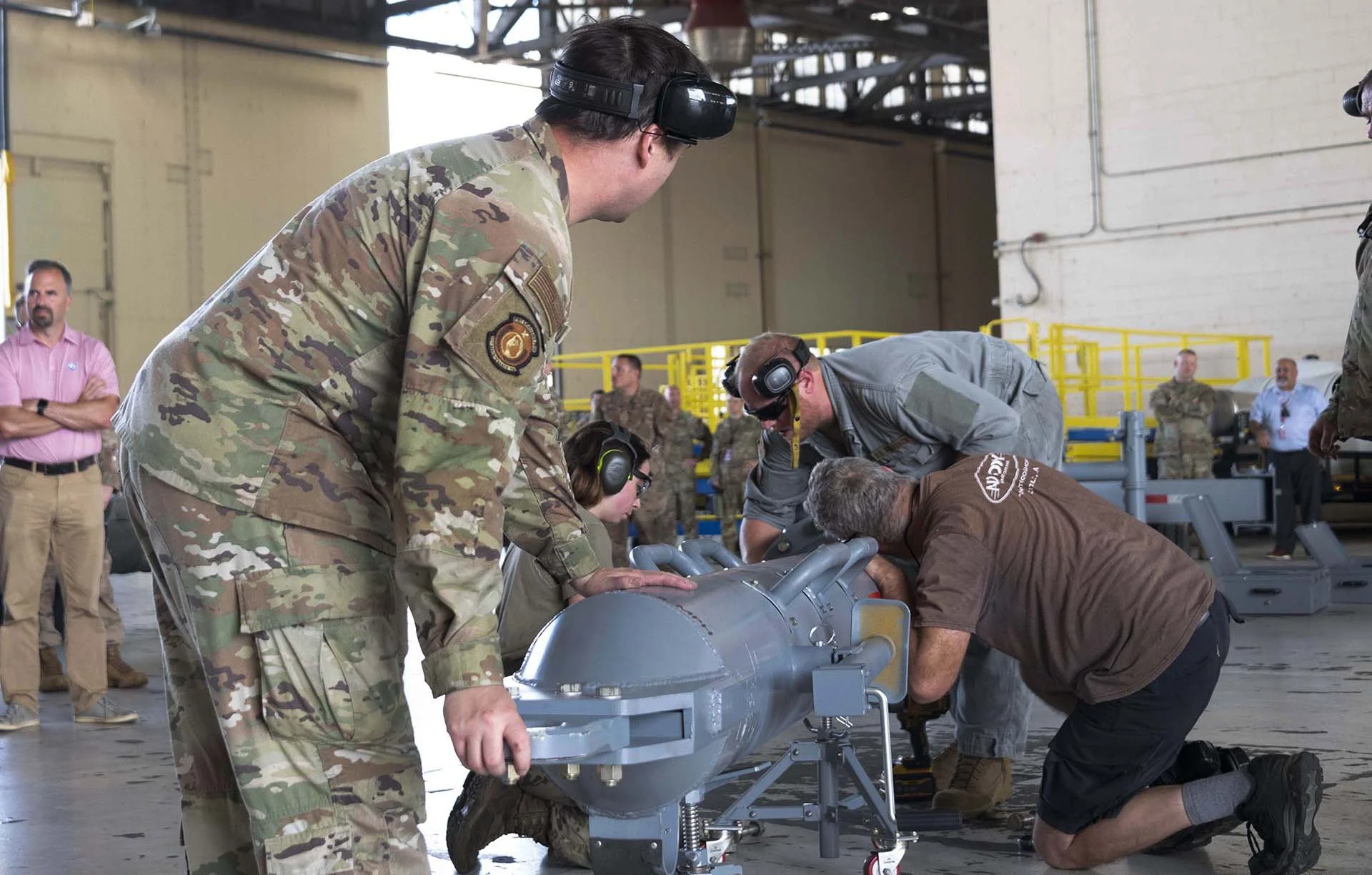
U.S. Airmen, assigned to the 307th Maintenance Squadron, and a U.S. Air Force civilian employees assemble a B-52 Stratofortress towbar prototype during a demonstration of its capabilities at Barksdale Air Force Base, Louisiana, Sept. 10, 2024. (U.S. Air Force photo by Senior Master Sgt. Ted Daigle)
The design met the goals of reducing the shipping footprint by 50% and decreasing the materials needed for shipping by nearly 100%. It also decreased failure points, which improved overall safety. This new prototype would potentially remedy concerns over mission readiness by taking less than 30 minutes to disassemble and rebuild.
Its design utilizes flange-style connections that allow the towbar to be disassembled into three pieces, saving transport space and time compared to the current towbar’s two-piece sleeve design. Flanges are aligned using a series of jack stands, then bolted together for assembly. To assist in moving, another series of jack stands on casters are used.
The University of Dayton Research Institute was commissioned to produce a report of the engineering analysis and process manual. They were then able to collaborate with AFGSC and AFRL to produce a full scale minimum viable prototype.
AFGSC leadership now looks to pursue production and scaling for use across the command.
Harnessing the power of STRIKEWERX innovation, the project’s end result was produced in 8 months, compared to the industry standard of 3-5 years and at far lower cost than if a traditional defense contractor had been chosen.
“The current design isn’t agile and that means that towing operations could be limited at our forward operating locations. Getting this equipment into the hands of our warfighter as quickly as possible will greatly mitigate those constraints. The work done by the senior design students at Louisiana Tech was essential for creating a real prototype that we can test and scale, at only a fraction of the cost and time that would normally be required by industry. Those savings prove our partnership with STRIKEWERX is a success.”
Visit the STRIKEWERX website HERE to see how it is helping provide new training solutions for the Air Force.