
ROTC Cadets government collaboration delivers results on UAS threat analysis
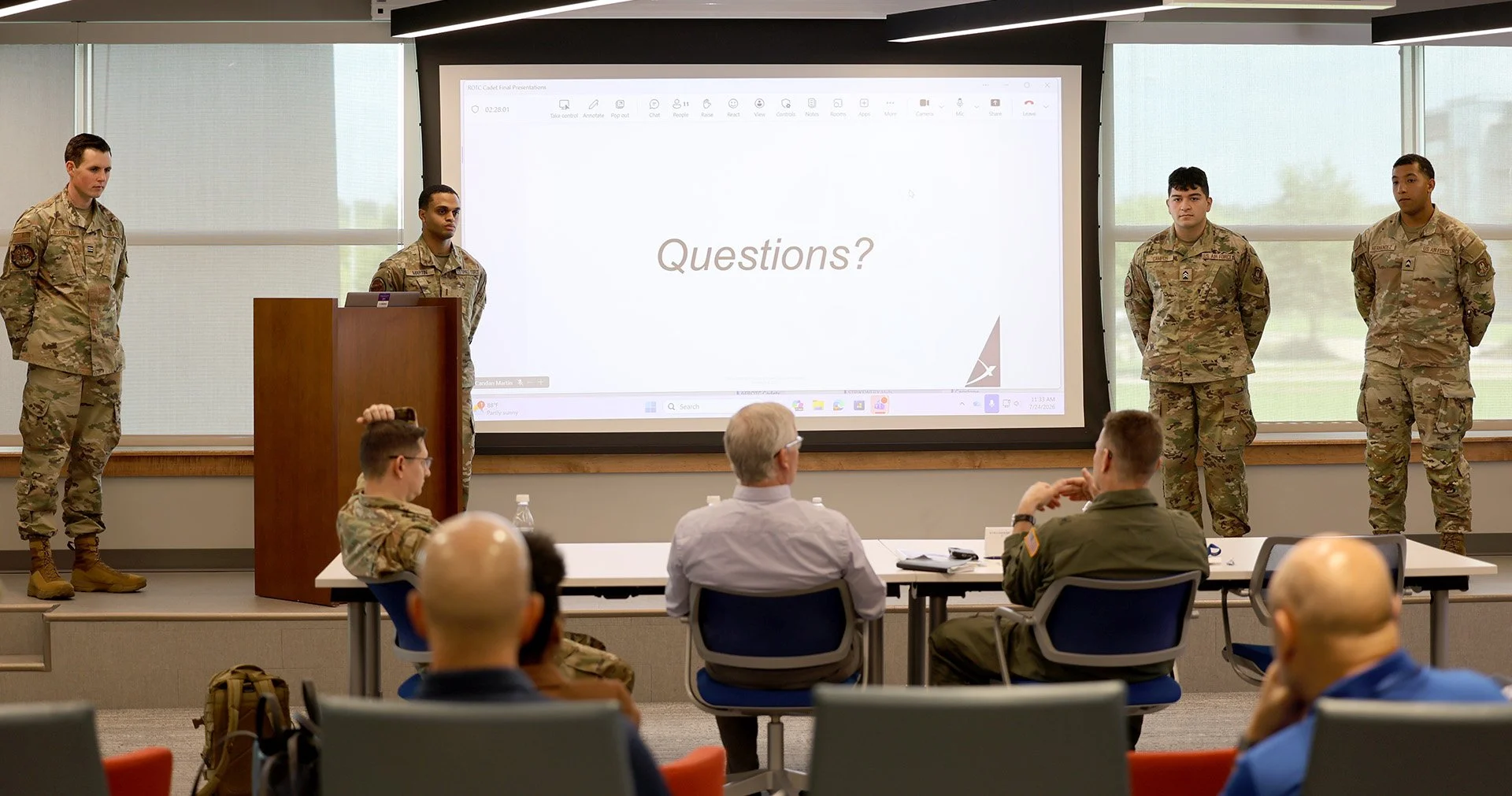
Thirteen U.S. Air Force Reserve Officer Training Corps cadets presented their accomplishments and lessons learned July 24 at STRIKEWERX, the innovation hub for AFGSC, located at the Cyber Innovation Center in Bossier City, Louisiana. One of the groups of cadets focused on simulating small unmanned aerial systems threats and how to defend against them. (U.S. Air Force Photo courtesy of STRIKEWERX)
By Sean Green | STRIKEWERX Facilitation and Outreach Manager
BOSSIER CITY, La. — U.S. Air Force Reserve Officer Training Corps (ROTC) cadets spent the summer in government collaboration to enhance Air Force Global Strike Command (AFGSC), including one project simulating drone warfare.
The fifth year of the ROTC Cadet Success Program at AFGSC featured 13 cadets from the University of Houston, Louisiana Tech University, Penn State, the University of Pittsburgh, the University of Texas, Texas A&M University, and the University of Texas at San Antonio (UTSA).
Working alongside mentors across the command, the cadets spent eight weeks gaining real-world experience while contributing to the advancement of systems, concepts, and technologies that enhance AFGSC capabilities. The program is funded by the Air Force Office of Scientific Research through Clarkson Aerospace Corp. and facilitated by the Cyber Innovation Center.
One project tasked cadets with simulating defenses against large swarms of small unmanned aerial systems (sUAS).
“This project will be critical in rapidly iterating the evolving threats and necessary counter measures, which will guide leadership’s investment strategies,” said U.S. Air Force Lt. Col. Nathan Haluska, project mentor and military liaison to the AFGSC Office of the Chief Scientist.
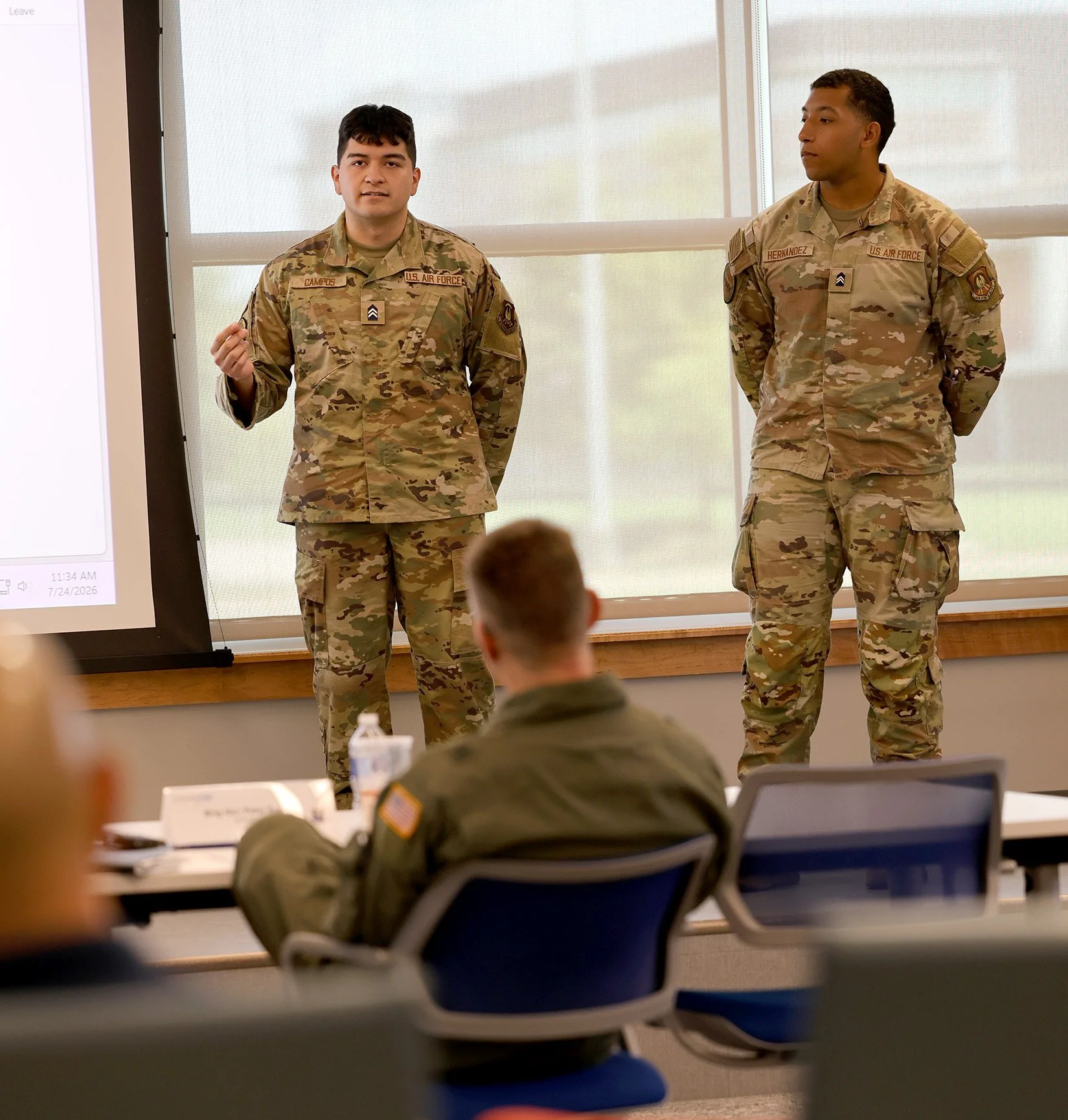
Thirteen U.S. Air Force Reserve Officer Training Corps cadets presented their accomplishments and lessons learned July 24 at STRIKEWERX, the innovation hub for AFGSC, located at the Cyber Innovation Center in Bossier City, Louisiana. (U.S. Air Force Photo courtesy of STRIKEWERX)
Haluska noted that future sUAS warfare will be largely executed and managed by the next generation of Air Force leaders. With that in mind, he encouraged cadets to think critically about counter-sUAS operations, work effectively in cross-disciplinary teams, and break down complex systems to better understand the scope of emerging threats.
“As our future leaders enter the Air Force, commanders will rely on them to think critically about today’s challenges and tomorrow’s unknowns,” said Haluska. “If our future leaders can translate the complex sUAS threat/countermeasure picture into simple performance metrics, then they can attack current problems while positioning themselves for the uncertainty of tomorrow.”
Candan Martin, a UTSA cadet joining the U.S. Space Force, said the team examined current UAS operations in wartime environments. The cadets then analyzed existing countermeasures and assessed their effectiveness.
“Artificial Intelligence (AI) and 3D printing has allowed smaller nations to deter a larger force, which drastically changes the complexion of future conflicts,” said Martin. “The work we’ve done here helped me learn to break a problem down to the lowest level. It’s good to understand the threats faced by other nations and how we could use that for our own needs.”
To support the project, the cadets collaborated with the HIVE, a strategy and problem-solving team within AFGSC. The partnership provided access to simulation software used to explore the effectiveness of various countermeasures against sUAS threats.
The project's results established a baseline for evaluating effectiveness of sUAS defense and laid the groundwork for future development efforts.
Jacob Campos, a UTSA cadet preparing to enter the U.S. Air Force, said the team’s collaboration with HIVE helped narrow the project scope and focus their research efforts.
“Getting HIVE’s views on base defense for drones and the future of warfare gave us new ideas on how to run the simulation and shift our focus on analyzing data,” Campos said. “My experience in the program left me with the skill to identify the issues and opportunities of any problem.”
The Office of the Chief Scientist and AFGSC's Strategic Plans, Programs and Requirements Directorate were impressed by the cadets’ ability to deliver a robust sUAS simulation and meaningful analytical results.
“A diverse team with backgrounds in computer science, aerospace engineering, and AI had 10 years of PhD level technical knowledge thrown at them in the span of weeks,” Haluska added, “and they took the initiative to implement this capability for the command.”